Master the Arc: Professional Guide to Welding Positions and Techniques
AWS & ASME Welding Standards – An Overview
First published by Knowledge regarding welding positions cannot be attained without awareness of the standards that govern these welding positions. The two most widely used welding standards around the globe are AWS (American Welding Society) and ASME (American Society of Mechanical Engineers). The standards help provide safety, quality, and recognition across the globe regarding welding positions.
AWS Welding Standards (AWS A3.0)
AWS A3.0M/A3.0 – Standard Welding Terms and Definitions is the most widely used resource for the definition of welding terms and symbols, and the positions of the weld.
Key Obj. Of AWS Standards:
- Offer common terms for Welding Technicians/Welders
- Standardize plate and pipe welding positions (1G, 2G, 3G, 4G)
- Make Possible Consistent Welder Qualification & Testing
- Promote clear communication between welders, inspectors, engineers, and fabricators
AWS standards are mostly used in:
- Steel structural fabrications
- Shipbuilding
- Automotive and General Manufacturing
- Welder training and certification courses
AWS deals mostly with definitions, symbols, and skill assessment, thus serving as a basis for knowledge about welding positions.
ASME Welding Standards-ASME Section IX
ASME Section IX-Welding, Brazing, and Fusing Qualifications address the qualification of welders, welding operators, and welding procedures. Use is required in pressure-related applications.
The key objectives of ASME Section IX:
- Qualify welding procedures (WPS & PQR)
- Qualify Welder Performance Certifications (WPQ)
- Define acceptance criteria for the positions of plate and pipe welding
- Ensure the integrity of welds under critical service conditions.
ASME standards have applicability in:
- Pressure vessels
- Boilers
- The power plants
- Oil & gas pipelines
- Refineries and process industries
Unlike AWS, ASME places strong emphasis on safety, mechanical performance, and repeatability under operating pressure and temperature conditions.
This article provides a clear and practical explanation of plate and pipe welding positions, their applications, and their importance in welder qualification.
Welding Positions of Plates and Pipes According to
AWS A3.0M/A3.0 & ASME Section IX
Knowledge of welding positions is a fundamental requirement for all welders, inspectors, engineers, and fabricators. Standardized welding test positions in plates as well as in pipes have been specified by AWS A3.0M/A3.0 and ASME Section IX.
This article gives a very lucid presentation of these welding positions, which are of significant importance.
Welding Positions for Plates
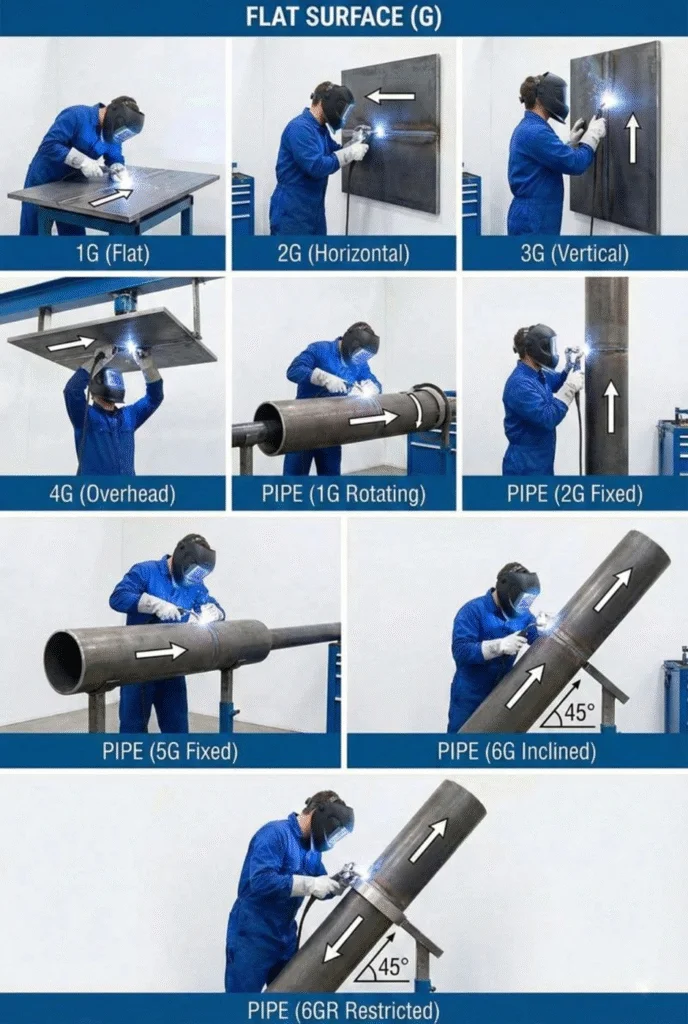
The plate welding positions are specified for linear groove joints. The positions assess a welding operator’s skill in handling molten metal against different gravitational pull factors.
1G – Plate (Flat Position)
The welding test position designation for a linear groove weld used on a joint where the weld is made in the flat position.
- Easiest welding position
- High quality of weld pool control
2G – Plate (Horizontal Position)
A designation representing the welding test position for a groove weld in a linear configuration applied to a joint when a welding is in the horizontal welding position.
- Plate is vertical; weld axis is horizontal
- Control of sag in the molten metal is required
- Commonly used in fabrication: structural
3G – Plate (Vertical Position)
It marks a welding test position designation for a line groove weld used on a joint that is welded in the vertical position.
- Issues when welding, may be vertical-up or
- Requires high-level heat and puddle management
- Common in pressure vessels, structural applications, etc.
4G – Plate (Overhead Position)
A designation for a welding test position indicating that a linear groove weld is being applied to a joint and the welding is in the overhead welding position.
• One of the most difficult plate positions
• Gravity is working against the welder
• Highly skillful and in control
Welding Positions for Pipes
The pipe welding position applies to circumferential groove welds. The pipe welding position is essential in piping applications such as oil, gas, power plant, refinery, process, and similar industries.
1G – Pipe (Rotated – Flat Position)
The welding test position designation for a circumferential groove weld with a joint on a pipe with an approximately horizontal axis, where the pipe is rotated around its axis, welded in the flat position.
• Rotations of the pipe can be continuous in nature, while
• Simplest pipe welding position
2G – Pipe (Horizontal Position)
Position for a welding test on a circumferential groove weld on a pipe with a pipe axis approximately vertical, when the pipe is welded in the horizontal position.
• Pipe may be fixed or rotated
• Vessel nozzles, vertical piping
3G – Pipe (Vertical Position)
Designation for a welding test position involving a circumferential groove weld on a pipe, with a horizontal axis, where the pipe is rotated on its axis to produce a vertical position for welding.
• Rotation can be either continuous or incremental
• Less commonly used in qualifications
4G – Pipe (Overhead Position)
A welding test position designation for a circumferential groove weld applied to a joint in pipe, whose axis is approximately horizontal, in which weld is made in the overhead welding position by rotating pipe about its axis.
• It demands strong control of the weld pool.
• Rotation can be either continuous or incremental
5G – Pipe (Fixed Horizontal Position)
Position designation of a welding test concerning a circumferential groove weld used on a pipe with a horizontal pipe axis, in which the circumferential groove is welded in the flat, vertical, and overhead positions.
• Pipe is fixed until completion of welding
• Commonly used in pipes, piping with pressure
• Skilled in multi-position welding
6G – Pipe (Fixed 45° Position)
Designation of a welding test position involving a circumferential groove weld on a pipe joint, with the axis at an angle of approximately 45° to the horizon, involving all three welding positions: horizontal, vertical, and overhead.
• Pipe is fixed
• Most demanding pipe welding test
• Commonly used in highly skill-demanding tasks
Final Thoughts
Welding position classifications defined by AWS A3.0M/A3.0 and ASME Section IX form the foundation of welder qualification and welding procedure control. Mastery of these positions ensures compliance, safety, and high-quality welds across industries.
Whether you are a welder, welding inspector, fabrication engineer, or quality professional, understanding these positions is essential for success in modern industrial welding.
#Welding #WeldingSkills #WeldingPractice #PipeWelding #IndustrialWelding #PrecisionWelding #StainlessSteelWelding #WeldingTechnology #CircumferentialWelding #MetalWork #Fabrication