Introduction
Selecting the proper welding process is critical to improving productivity, weld quality, operational efficiency, and production costs. In 2026, manufacturing industries are still using various welding techniques according to the type of materials, thickness of the components, fabrication process, and the amount of production.
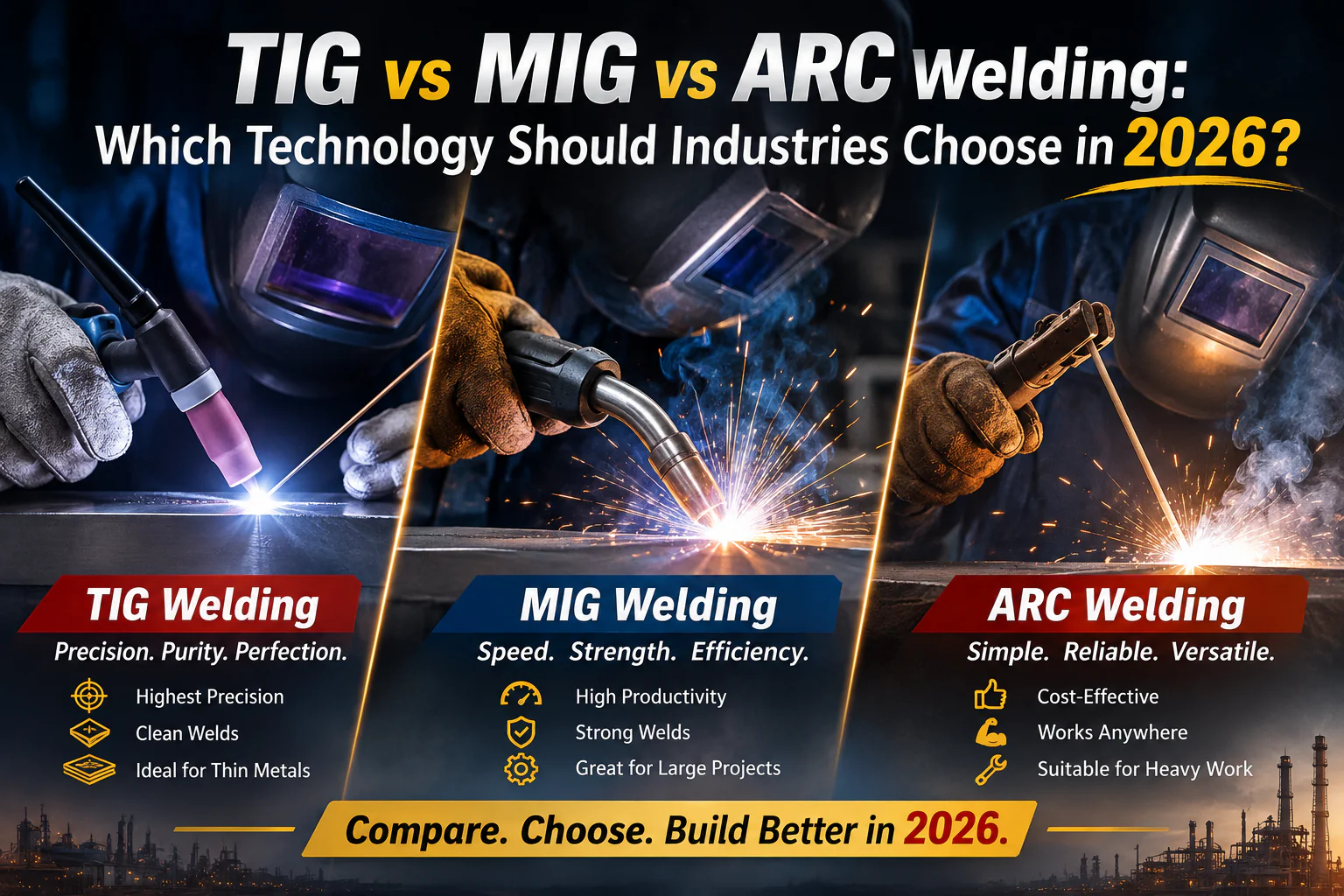
The most popular industrial welding processes include TIG Welding, MIG Welding, and ARC Welding. All three of them have their specific features, drawbacks, equipment required, and industrial applications.
TIG welding is famous for its great precision and high-quality results. MIG welding ensures high productivity due to continuous wire feeding, and conventional ARC Welding is also known as Stick or MMA welding. It is versatile, portable, and suitable for maintenance and construction work.
For industrial manufacturers, the ability to distinguish between TIG vs MIG vs ARC welding is very important to select the appropriate technology.
Here is a comparison of three welding processes according to weld quality, material compatibility, productivity, cost, equipment required, and industrial applications.
What Is TIG Welding?
TIG Welding is referred to as Tungsten Inert Gas Welding and scientifically called Gas Tungsten Arc Welding (GTAW).
The technique utilizes a non-consumable tungsten electrode, which creates an arc between the electrode and the workpiece. An inert shielding gas such as argon or suitable gas mixture is used to protect the weld from atmospheric contamination.
A filler material may be used separately if needed. Sometimes, TIG welding can be carried out without any filler material.
Key Features of TIG Welding
- High degree of control over the process of welding
- Precise and clean welds when done properly
- Good for thin metals and intricate joints
- Very high control over heat input
- Has compatibility with many types of metals
- Requires more skill and slow speed compared to MIG welding
Industrial Applications of TIG Welding
TIG welding is commonly used for:
- Stainless steel fabrications
- Components made from aluminium with appropriate AC TIG equipment
- Metal sheet fabrications
- Precision engineering
- Food processing machinery
- Pharmaceutical machinery
- Aerospace parts
- Selected pipe and tube welding projects
TIG welding is particularly useful when appearance, precision, and control over the weld pool are important.
What Is MIG Welding?
Metal Inert Gas welding is referred to as MIG welding and is often combined with MAG welding as Gas Metal Arc Welding (GMAW).
The process employs a continuous feed of a wire electrode. An arc melts both the wire electrode and the workpiece, and the shielding gas prevents contamination of the weld pool.
When referring to steel structures fabricated in industry using active gases or gas mixtures, MIG/MAG welding is technically correct.
Key Features of MIG/MAG Welding
- Continuous wire feeding
- High efficiency in welding in appropriate applications
- Less need to replace electrodes
- Appropriate for mechanization and automation of welding
- Welding efficiency maintained if correctly set up
- Wide range of fabrications that can be welded
Industrial Applications of MIG/MAG Welding
MIG/MAG welding is widely used in:
- Fabrication processes
- Vehicle construction
- Structural steel fabrication
- Machine construction
- Railway parts construction
- Ship building
- Industrial equipment manufacturing
- Pressure vessel fabrication, where allowed under the applicable code and procedure
- Automated welding production line
For medium- and high-volume manufacturing, MIG/MAG welding can help improve production efficiency because the welding wire is fed continuously.
What Is ARC Welding?
In industrial shops, ARC welding is synonymous with Shielded Metal Arc Welding (SMAW), which is also referred to as Stick or Manual Metal Arc (MMA) welding.
It involves an electrode covered with flux, where the electric arc melts the electrode and the metal being welded, and the flux coating produces shielding gases and a slag on the welded joint.
In contrast with MIG welding, ARC welding generally does not need a shielding gas cylinder.
Key Features of ARC Welding
- Simple, versatile equipment
- Can be used for a variety of construction and maintenance applications
- Does not need a separate source of shield gas
- Suitable for a variety of outdoor welding jobs
- Works well with a variety of ferrous metals
- Involves electrode changes and slag cleaning
- Is less productive compared to MIG welding for repetitive tasks
Industrial Applications of ARC Welding
ARC welding is commonly used in:
- Construction and Infrastructure
- Erection of Steel Structures
- Industrial Maintenance
- Repair of Equipment
- Pipeline and Field Fabrication provided that the procedure allows it
- Heavy Engineering
- General Fabrication
- Welding in the open air
Its versatility makes ARC welding a practical choice when portability, access, and simple setup are important.
TIG vs MIG vs ARC Welding: Key Differences
The following table compares the three welding processes across important industrial selection criteria.
| Feature | TIG Welding | MIG/MAG Welding | ARC/Stick Welding |
| Technical name | GTAW | GMAW | SMAW/MMA |
| Electrode | Non-consumable tungsten | Continuously fed consumable wire | Consumable flux-coated electrode |
| Shielding | Usually inert gas | Inert or active gas, depending on process | Flux coating provides shielding |
| Filler metal | Optional, usually separate | Continuously fed wire | Electrode itself provides filler |
| Weld control | Very high | High with correct setup | Depends strongly on operator technique |
| Welding speed | Generally slower | Generally faster in suitable applications | Often slower for repetitive production |
| Thin material capability | Excellent with suitable setup | Good with suitable parameters | More challenging on very thin sections |
| Thick material capability | Possible, but may be slower | High productivity with suitable equipment | Effective for many field and heavy-duty applications |
| Automation suitability | Possible | Excellent | Possible in specialized systems, but less commonly automated |
| Slag removal | Normally no slag | Normally no slag with solid wire; flux-cored processes differ | Usually required |
| Outdoor use | Sensitive to shielding gas disturbance | Sensitive to shielding gas disturbance | Often practical outdoors |
| Operator skill | High | Moderate to high, depending on application | Requires appropriate electrode and technique skills |
| Typical strength | Precision and control | Productivity and versatility | Portability and flexibility |
Important: Weld quality and strength are not determined by the welding process alone. They also depend on the base material, joint design, filler metal, welding procedure, operator qualification, and inspection requirements.
TIG vs MIG vs ARC Welding: Which Produces the Best Weld Quality?
There is no single best process for every application. The ideal process depends on the required weld characteristics and the manufacturing conditions.
TIG Welding: Precision and Finish
TIG Welding offers superb control of the arc and weld pool. The process is usually recommended for jobs where precise heat input, good-looking welds, and precise metal deposition is needed.
It could be especially beneficial for thin stainless steel parts, aluminium fabrication and precision engineering.
However, TIG welding often takes more time than other processes and involves higher skill level of the operator.
MIG/MAG Welding: Consistency and Productivity
MIG/MAG welding is ideal for welding situations requiring consistency and productivity.
Continuous wire feeding prevents interruptions and can be set up to operate either manually or automatically.
Control of voltage, wire feeding speed, travel speed, shielding gases, and joint preparations is key to preventing any defects.
ARC Welding: Versatility and Field Performance
ARC welding is applicable to works in the field, for repairing and wherever simplicity and versatility in the use of equipment is necessary.
High quality of welding is attainable using the right kind of electrodes, the correct process, and proper techniques. But changing of electrodes, slag cleaning, and manual handling will add up to the processing time.
Industrial recommendation: For precision, select TIG; for efficient production, choose MIG/MAG; and for portability and field work, select ARC welding.
Which Welding Process Is Best for Different Materials?
Material compatibility is one of the most important factors when choosing a welding machine.
Mild Steel and Carbon Steel
The MIG/MAG process is very common in carbon steel work due to its efficiency and uninterrupted feeding of the wire. ARC Welding is another commonly used method in construction work, maintenance and fabrication works in the field.
Stainless Steel
Welding by TIG process is preferred for thin stainless steel sections. The MIG/MAG welding process may be a better option for large sections or high-volume work.
This will depend on the thickness of material, joint geometry, corrosion specifications, and the welding procedure specification..
Aluminium
Suitable AC TIG welding is generally chosen for accurate welding of aluminum. MIG welding is effective for welding thick aluminum and for high production welding, assuming that the wire feeding and process parameters are set up properly.
Aluminum needs proper surface preparation, appropriate materials, and correct process controls.
Stick welding is less useful for aluminum welding applications.
Alloy and Special Materials
With regard to alloy steels, nickel alloys, and other special materials, the correct welding process is dependent upon the material composition, service conditions, joint design, and mechanical properties required.
The correct welding process should be established through a qualified welding procedure.
Productivity Comparison: TIG vs MIG vs ARC Welding
Productivity is an important consideration for industrial manufacturing, especially when dealing with large production volumes or repetitive fabrication work.
TIG Welding Productivity
Deposition rates in TIG welding are typically lower compared to MIG and MAG welding. However, TIG welding does not always need separate filler metal addition and torch movement.
Nevertheless, TIG welding reduces the need for finishing work in appropriate applications.
MIG/MAG Welding Productivity
MIG/MAG welding has continuous wire feeding and high deposition rate provided that operating conditions are right.
Productivity in MIG/MAG welding can be improved by proper choice of process, correct joint preparation, good wire feeding mechanism, and mechanized welding process.
ARC Welding Productivity
ARC welding is flexible and suitable for repairing and outdoor works, as well as hard-to-reach joints.
Nevertheless, electrode change, slag removal, and readjustment may lower the arc-on time during repetitive manufacturing operations.
Productivity Summary
| Production Requirement | Commonly Suitable Process |
| High-volume steel fabrication | MIG/MAG |
| Precision welding of thin stainless steel | TIG |
| General construction and field repairs | ARC/Stick |
| Repetitive automated welding | MIG/MAG |
| Detailed welding with controlled filler addition | TIG |
| Maintenance in locations without shielding gas | ARC/Stick |
The actual productivity of each process depends on the joint design, material, welding position, required quality, operator skill, and production layout.
Equipment Requirements: TIG vs MIG vs ARC Welding
Understanding equipment requirements helps manufacturers plan installation, operating costs, consumables, and maintenance.
TIG Welding Equipment
A typical TIG setup includes:
- TIG welding power supply
- TIG welding torch
- Tungsten electrode
- Cylinder with shielding gas
- Welding cables and return lead
- Filler rods, if necessary
- Proper accessories and safety gear
Some applications require AC output, pulse controls, or specialised torch configurations.
MIG/MAG Welding Equipment
A typical MIG/MAG system includes:
- MIG/MAG welding power supply
- Wire feeder
- Welding torch
- Spool of welding wire
- Shielding gas cylinder and regulator
- Welding cables and cable return
- Contact tips and liner kits
Industrial systems may also incorporate water cooling, digital controls, pulse functions, welding carriages, positioners, and automation interfaces.
ARC Welding Equipment
A typical ARC welding setup includes:
- ARC welding power source
- Electrode holder
- Welding electrodes
- Earth/return clamp and cables
- Protective equipment
- Electrode storage and handling equipment, as required
ARC systems are generally straightforward to set up and can be practical for mobile operations.
Welding Machine Cost and Operating Expenses
The purchase price of a welding machine is only one part of its total cost.
Industrial buyers should consider the total cost of ownership, including:
- Costs for equipment purchase
- Energy usage
- Materials used in welding
- Gas
- Workforce requirements
- Maintenance
- Re-work and finishing
- Idle time
- Output
The TIG welding process may incur higher costs in terms of labor owing to its slow deposition rate. MIG/MAG welding is able to decrease production time in applicable large-scale production. The ARC welding process may be simpler in terms of setup but may require more consumables for some operations.
The most economic method is that which satisfies quality and safety considerations and achieves the best production performance.
How Welding Automation Is Changing Industrial Manufacturing in 2026
Today, industrial producers are beginning to consider mechanized welding and automation to achieve increased consistency and control of their production processes.
Continuous wire feed MIG/MAG welding is especially appropriate for numerous automatic operations due to its continuous wire feeding process.
Welding automation systems include:
1. Welding Positioners
The positioner is used to rotate or tilt the workpiece to give better access to the joint. It is helpful in repetitive welding of compatible cylinders and fabricated structures.
2. Column & Boom Welding Systems
The Column & Boom method allows for precise placement of the welding equipment in case of big parts and repeated welding processes. According to its specific purpose, Column & Boom can be combined with an appropriate MIG/MAG or subarc welding equipment.
3. Welding Carriages
The mechanized carriages help to direct the torch in the desired path and regulate the travel speed for appropriate joints.
4. Robotic Welding Systems
The robotic welding process can be employed to produce repetitive parts that have the same geometries and proper programming.
5. Digital Welding Controls
Digital controls assist in setting up welding parameters and repeating them time and again. Moreover, sophisticated monitoring and control systems may contribute to process consistency in case they are appropriately utilized.
Automation doesn’t necessarily ensure defect-free welds. Process qualification, proper equipment, operator control, and necessary inspection all become necessary.
Common Welding Defects and How to Prevent Them
Regardless of the process selected, proper preparation and process control are necessary for reliable weld quality.
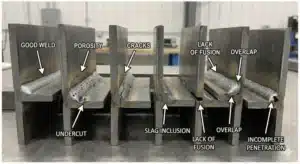
| Welding Defect | Possible Cause | Prevention |
| Porosity | Contamination or inadequate shielding | Clean surfaces and verify shielding conditions |
| Lack of fusion | Incorrect parameters or poor technique | Check joint preparation and qualified settings |
| Undercut | Incorrect heat input or travel speed | Optimise parameters and torch technique |
| Excessive spatter | Unsuitable process settings | Adjust voltage, wire feed, and transfer mode |
| Slag inclusions | Inadequate slag removal or poor technique | Clean between passes and follow the procedure |
| Distortion | Excessive or uneven heat input | Plan weld sequence and control heat input |
The applicable acceptance criteria and repair procedures must be followed for critical industrial components.
How to Choose the Right Welding Process for Your Industr
Before choosing between a TIG, MIG/MAG or ARC welding machine, consider the following aspects.
1. Material: Decide on the nature of the material, which could be carbon steel, stainless steel, aluminium, or other alloy.
2. Thickness of the material: The thickness could range from thin sheets to thick plates.
3. Quantity of production: High quantity production will do well using MIG/MAG or automatic welding, while low volume and repair will be suited for ARC or TIG according to the joint used.
4. Weld quality needed: Visual aspect, depth, mechanical properties, corrosion properties, and inspections.
5. Working environment: If welding is done outdoors, then ARC welding is ideal because the shielding gases might be exposed to the wind.
6. Available power supply: Check input voltage, phase and electricity consumption.
7. Operator’s skills: Check the operator’s skills level and complexity of the welding process.
8. Automation of the process: If the process requires positioners, carriages, Column & Boom system, or robot, then check for process and equipment compatibility.
9. Operating costs: Compare cost of consumables, labour, electricity, maintenance and downtime.
10. Technical support: Documentation and application support of the equipment.
Why Choose APS Welding for Industrial Welding Equipment?
Advanced Power Sources Limited (APS Welding), based in Gujarat, India, manufactures equipment for industrial and fabrication purposes.
The products include:
- MIG/MAG welding machines
- TIG welding machines
- ARC welding machines
- Submerged arc welding machines
- Plasma cutting machines
- Welding automation systems
- Positioners and related welding equipment
APS Welding caters to a variety of industries such as heavy fabrication, steel plant, ship building, railways, oil and gas, power plant, cement, and engineering in general.
While choosing between different types of TIG, MIG/MAG, and ARC welding, it is necessary that the proper equipment is chosen as per the material type, production capacity, duty cycle, production volume, and the working conditions.
APS Welding can help you with any industrial welding needs you may have and provide appropriate welding equipment.
Frequently Asked Questions (FAQs)
1. What is the main difference between TIG, MIG, and ARC welding?
TIG utilizes a non-consumable tungsten electrode, and the filler metal is usually added separately. MIG/MAG makes use of a continuously supplied consumable wire electrode along with the use of shielding gas. ARC/Stick utilizes a consumable flux-covered electrode.
2. Which is better: TIG or MIG welding?
In many cases, TIG welding is more suitable for precision work, while MIG/MAG welding is more productive in fabrication. The proper selection should be based on many factors, including material type, joint configuration, quality needs, and volume of production.
3. Is ARC welding stronger than MIG welding?
There is no single process that is always better than another for all applications. The strength of welds will depend on many factors, including the base material and the filler metal.
4. Which welding process is best for industrial fabrication?
MIG/MAG welding is widely preferred when productivity is high. TIG welding is best suited for precision works, whereas arc welding is most suitable for construction work.
5. Which welding process is best for stainless steel?
TIG is generally used for more precise work in stainless steel, especially with thinner gauges of material. MIG/MAG might be more productive for large parts and mass production applications. The choice of process depends on the material and the qualification process.
6. Can MIG welding be automated?
Of course. There is potential for integration of MIG/MAG welding with welding carriages, positioners, manipulators and robotics where appropriate.
7. Which welding machine is best for beginners?
Choice of the machine will depend on the purpose, material, power source, cost, and training. Arc welding could be a good choice to begin with for basic repairs on steel, while MIG welding could be simpler to learn for many beginners.
8. Which welding process is most economical?
The most efficient method will depend on the overall cost of ownership. MIG/MAG can be efficient in high-volume manufacturing, ARC in appropriate field and maintenance applications, and TIG where extra time is worthwhile due to quality and accuracy requirements.
9. Is MIG welding suitable for boiler and pressure vessel manufacturing?
MIG/MAG may be acceptable for certain joints and pieces, while pressure retention welds should adhere to the pertinent construction code and the relevant welding procedure. The appropriate process shall be determined by the qualified welding personnel.
10. What should I check before buying an industrial welding machine?
Evaluate output current, duty cycle, input voltage, material compatibility, required welding process, consumables, operating costs, service support, and automation compatibility.
Conclusion
TIG welding, MIG/MAG welding, and ARC welding all hold their place in today’s industrial manufacturing industry. TIG welding provides accurate results, MIG/MAG welding ensures high productivity, while ARC welding is flexible enough for construction work and maintenance work.
The best welding process for industrial manufacturers in 2026 will not be the process with the highest amperage output or lowest purchase cost. It will be the process that matches the necessary weld quality, material requirements, productivity, safety, and cost of operation.
A proper assessment of the welding application and equipment selection can help the manufacturers increase productivity, get consistent weld quality, and make good equipment choices.
Need an industrial welding machine for your manufacturing business? Call APS Welding for MIG/MAG, TIG, ARC, and welding automation equipment.