Travel Speed and Welding Current Are Key to a Good Weld, Beyond Merging Two Metals Together
Every good weld starts way ahead of the actual welding process. Though choosing an appropriate welding machine, electrode, and welding rod is crucial, the real quality of the weld will depend on how well the welder manages two critical parameters – travel speed and welding current.
Both these factors determine how much heat gets into the joint, affecting the weld’s penetration, fusion, bead formation, distortion, strength, and reliability.
If you work on pressure vessel fabrication, shipbuilding, pipe welding, wind tower construction, railway equipment manufacturing, or other types of industrial welding, then knowledge about the interaction of travel speed and welding current is vital.
This professional guide explains all about the impact of these parameters on weld quality, resulting weld defects, and best practices for industrial welding.
What Is Welding Current?
Current in welding, which is in ampere (A), refers to the electric current that flows through the welding circuit. It provides the heat necessary for melting of both the parent metal and the filler metal to form a metallurgical bond.
The choice of current influences:
• Stability of arc
• Heat input
• Penetration of weld
• Deposition rate
• Melting rate of electrode
• Size of weld bead
• Productivity
Choosing the right amperage will ensure adequate penetration but avoid excessive heating of the metal.
What Is Travel Speed in Welding?
The travel speed is the velocity of movement of the welding torch or electrode on the weld joint.
It might seem to be a simple concept, but travel speed is of crucial importance when it comes to controlling heat dissipation and bead creation.
Any variation in travel speed can have a considerable impact on:
• weld penetration
• fusion
• bead width
• Heat Affected Zone (HAZ)
• distortion
• visual appearance of weld
Why Travel Speed and Welding Current Must Work Together
Most welders pay attention either to increasing or decreasing the amperage, but do not care about the travel speed or vice-versa. On the contrary, both of these parameters are used to manage the heat input, which is one of the main components of welding.
If the current is raised, the amount of heat rises.
If the travel speed is decreased, the heat is distributed for a longer time in the area of the joint.
It means that there is an increase in heat input.
On the other hand, low current with fast travel speed causes insufficient heat.
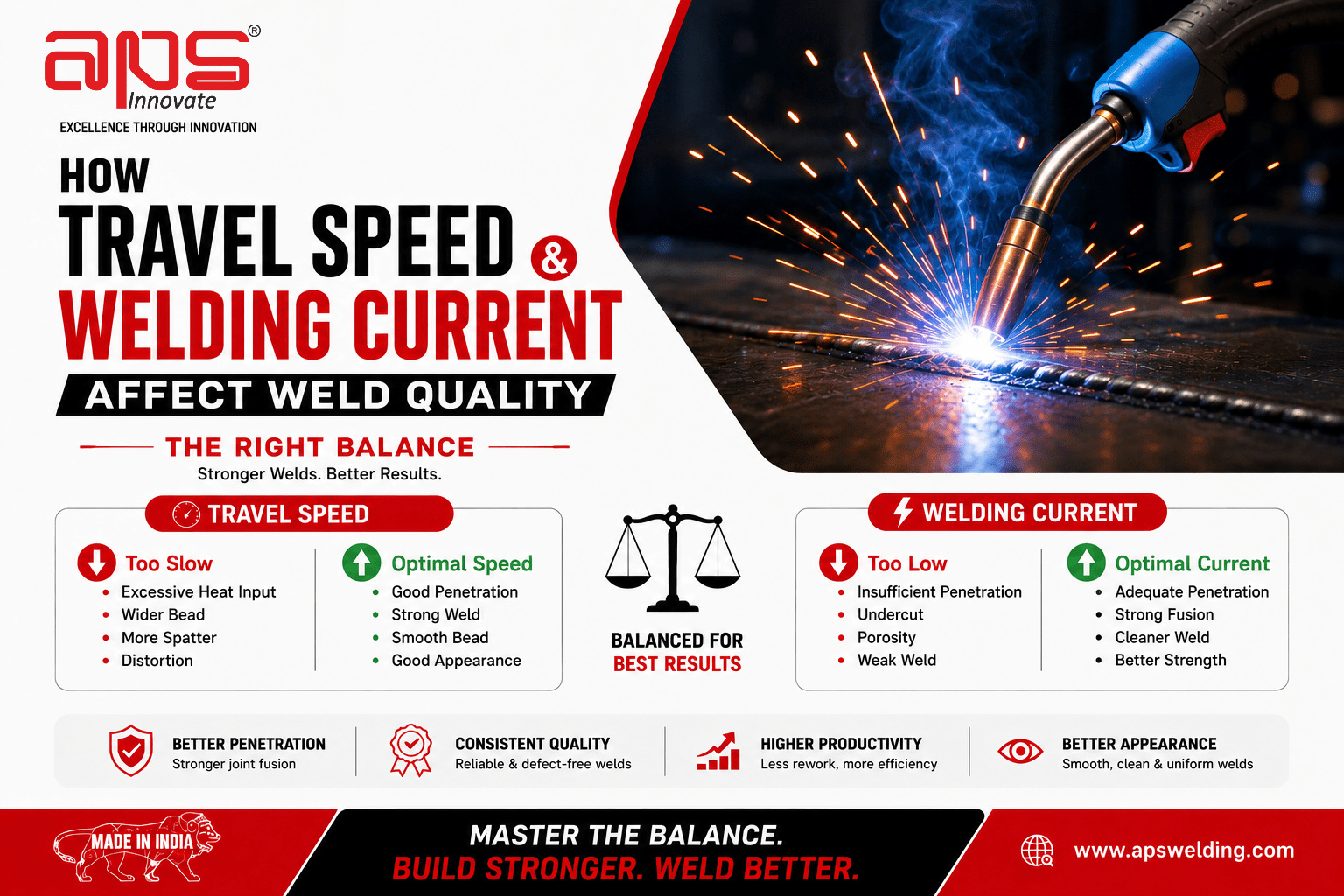
Effect of Slow Travel Speed on Weld Quality
A slow travel speed causes an accumulation of excess heat in the base metal.
Typical Features
• Wide weld bead
• Excess reinforcement
• Large Heat Affected Zone (HAZ)
• High degree of distortion
• High penetration
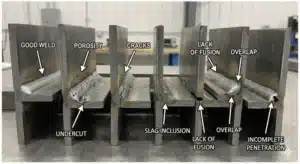
Common Welding Defects
- Burn-through
- Excess weld metal
- Warping
- Increased residual stress
- Reduced production efficiency
Although the weld may appear strong, excessive heat can negatively affect the surrounding material and increase post-weld corrections.
How Fast Travel Speed Affects Weld Quality
Moving too quickly prevents the weld pool from properly fusing with the base material.
Common Characteristics
- Narrow bead
- Shallow penetration
- Thin reinforcement
- Poor sidewall fusion
- Uneven bead profile
Common Welding Defects
- Lack of fusion
- Incomplete penetration
- Undercut
- Weak weld joints
- Reduced structural integrity
This is one of the most common causes of weld failure in industrial fabrication.
Effects of High Welding Current
Increasing welding current increases heat generation.
While higher amperage can improve deposition rates, excessive current often creates more problems than benefits.
Common Characteristics
- Wider weld bead
- Deep penetration
- Increased spatter
- Larger Heat Affected Zone
- Higher electrode consumption
Common Defects
- Burn-through
- Undercut
- Excessive penetration
- Distortion
- Poor surface appearance
Higher current should always be balanced with an appropriate travel speed.
Effects of Low Welding Current
Insufficient welding current reduces the heat available for proper fusion.
Common Characteristics
- Narrow bead
- Rope-like weld profile
- Poor penetration
- Arc instability
Common Defects
- Slag inclusions
- Cold lap
- Lack of fusion
- Weak joints
- Reduced mechanical strength
Although low current minimizes distortion, it can severely compromise the strength and durability of the weld.
Reading a Weld Bead: What Your Weld Is Telling You
Experienced welders often diagnose welding problems simply by examining the finished weld.
A High-Quality Weld Should Have:
- Uniform bead width
- Consistent ripple pattern
- Smooth transitions
- Proper reinforcement
- Adequate penetration
- Minimal spatter
What Different Weld Beads Indicate
| Weld Appearance | Possible Cause |
| Wide bead | Travel speed too slow |
| Narrow bead | Travel speed too fast |
| Heavy spatter | Welding current too high |
| Rope-like bead | Welding current too low |
| Undercut | High current or excessive travel speed |
| Poor penetration | Low current or excessive travel speed |
| Burn-through | High current combined with slow travel speed |
Understanding these visual indicators helps welders make quick parameter adjustments before defects become costly.
Heat Input: Understanding The Welding Process
Heat input is defined as the amount of energy supplied to the workpiece during the process of welding. The heat input affects the following aspects:
• Penetration
• Strength
• Grain structure
• Toughness
• Distortion
• Stress
• Corrosion resistance
Excess heat increases the Heat Affected Zone (HAZ) leading to distortion of the properties of the workpiece.
Less heat leads to poor joint formation and penetration.
The aim of the whole process is to maintain heat input in an ideal condition.
Best Welding Parameter Practices for Different Processes
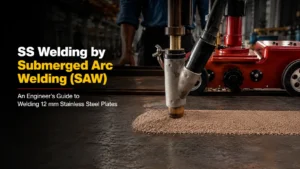
Submerged Arc Welding (SAW)
SAW usually runs at high currents and moderate traveling speed, providing:
• Increased penetration
• High deposition
• High productivity
• Less spatter
• High quality of welds
It is commonly used for pressure vessel construction, pipeline welding, wind tower construction, structural steel manufacturing, and heavy engineering.
MIG/MAG Welding
MIG/MAG welding requires careful coordination between:
- Voltage
- Wire feed speed
- Welding current
- Travel speed
Balanced settings produce smooth welds with excellent appearance and minimal post-processing.
Shielded Metal Arc Welding (SMAW)
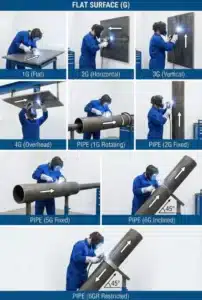
For SMAW, current selection depends on electrode diameter, material thickness, and welding position, while travel speed is controlled by the welder’s technique.
Hard Facing
Hard-facing applications require carefully controlled heat input to preserve wear-resistant alloys and minimize dilution.
Gouging
Carbon arc gouging uses significantly higher current to remove metal efficiently before repair welding.
Why Modern Inverter Welding Machines Perform Better
Modern inverter welding machines provide better parameter control than transformer machines do.
Some of their key advantages include:
• Stable arc performance
• Accurate current regulation
• Consistent weld penetration
• Less spatter
• Efficient electricity usage
• Lower power consumption
• Greater productivity
These factors allow manufacturers to deliver a consistently good weld quality during the entire production cycle.
Why Choose APS Welding
APS Welding is well aware of how important precision is for industrial welding.
For example, our Endeavour 1250 CCCV Submerged Arc Welding Machine was developed with those requirements in mind.
This machine offers:
• 1250A robust output capacity
• 1000A at 100% duty cycle
• Five welding operations in one machine
• High-tech 20 kHz Module IGBT inverter technology
• More than 85% energy efficiency
• Wide 365-500 VAC input voltage range
• Stable arc with great penetration
• Low spatter and consistent bead quality
• Durability and designed for 24×7 continuous industrial operation
Whether your job involves manufacturing pressure vessels, boilers, pipelines, wind towers, railway equipment or heavy structures, APS Welding will provide you with consistent and defect-free welds.
Frequently Asked Questions (FAQ)
Why is it necessary to have proper travel speed in welding?
Travel speed affects heat input, weld penetration, weld bead formation, and fusion. Traveling too slow may cause lack of fusion, burn-through, distortion, and poor weld formation.
What will happen when the welding current is too high?
High current causes high heat input which results in burn-through, undercut, excessive penetration, spatter, and distortion.
What will happen when travel speed is too fast?
High travel speed causes low heat input leading to poor weld penetration and incomplete fusion.
How does welding current and travel speed affect each other?
The welding current affects the amount of heat produced and the travel speed affects the amount of time that heat is applied.
Which process usually employs the highest welding current?
Submerged Arc Welding (SAW) has the highest welding current among the welding processes.
Conclusion
However, an excellent weld never happens by accident; rather, it happens as a consequence of having control over the welding process.
The two most important factors that determine weld penetration, fusion, heat input, bead shape, distortion, and mechanical properties are travel speed and welding current. The proper use of these two will result in very robust welds that have the highest quality standards in the industry.
No matter whether you use SAW, MIG/MAG, SMAW, Hard Facing, or Gouging, it is very important to have control over the welding parameters to improve your efficiency and save money.
At APS Welding, we provide our clients with advanced welding technologies and knowledge to reach outstanding welding results. Since an excellent weld is not just the joining of two materials; it is the result of control over every single welding parameter.